
01 · THE FIRST DRAFTLooks finished
Good visuals. Unanswered questions.
Which customers? What date range? Are refunds included? What counts as revenue?
THE ACCIDENTAL ANALYST · STEPHEN McDANIEL
Better evidence. Better judgment. Decisions you can defend.
I train finance and analytics teams to verify AI-assisted analysis, challenge assumptions, and confidently recommend the next business decision using approved company data.
Six-week private program for one company, up to 12 participants. Meet your instructor →
LOOKS CONVINCING. PROVE IT.
AI can make a dashboard or forecast look finished in minutes. Your team still needs to test definitions, calculations, alternative explanations, and what the evidence actually supports.
Which customers? What date range? Are refunds included? What counts as revenue?
Clear metric definitions, comparable periods, verified calculations, and a decision the dashboard can support.
Illustrative example of the verification process.
OUR FLAGSHIP · PRIVATE TEAM TRAINING
Your team brings a real business decision. I teach them to turn the data and AI-assisted analysis into a recommendation they can explain, verify, and defend.
Includes guided case work, reusable verification templates, private recordings, and an executive capstone. This is coached analytical practice, not outsourced engineering or dashboard production.
Not ready for the full program? An optional $3,000 five-day Decision Integrity Diagnostic can establish the gap first; the fee is credited toward the Accelerator within 30 days. After the Accelerator, eligible companies can continue in a private $5,000/month Decision Integrity Practice Lab using their approved team work. This is separate from the public $450/quarter Data Craft Workshop.
FREE EXECUTIVE ANALYTICS EXAMPLES
Watch Stephen challenge plausible AI outputs and investigate the decision behind the numbers. New demonstrations and archived Claude Dashboard Daily builds remain free.
Featured analysis: The $5M Netflix Mistake Most Data Analysts Still Make
The free library contains more examples, and subscribers can follow the working files.
FREE · EXECUTIVE ANALYTICAL JUDGMENT
One focused executive analytics demonstration each week, plus the existing free library. Explore what the AI gets right, what needs investigation, and how to make a recommendation more defensible.
“Looks convincing. Prove it.” It's a habit worth teaching.
Browse the free example library →FOR INDIVIDUAL ANALYSTS · SELF-PACED COURSE
Build Strategic, Tactical, and Operational Dashboards Executives Trust.
$399 founding price First 50 customers · then $499
The Daily shows the build. The course teaches the method behind it: define the business question, verify every critical number, and design the view each audience needs to act.
See the Course and Founding PriceCurriculum, FAQs, and enrollment details are on the course page.
LIVE EVERY THURSDAY · NOON CENTRAL
For individual analysts: practice weekly with Stephen’s prepared examples and non-confidential data. Get working files in advance, ask questions live, and keep the replays. Not private company-project review.
See the weekly workshop →TWO WAYS TO WORK WITH STEPHEN
Learn and practice together as an individual, or help your whole team work on a real company decision. These are different experiences, not levels of the same subscription.
Data Craft Workshop: $450/quarter. Public Thursday sessions with Stephen's prepared datasets, group Q&A, and working files. No private client-data reviews.
Explore weekly Data Craft practice →Decision-Ready Accelerator: $25K founding, then $39K. Use one approved company case in a private six-week program. Afterward, select teams can continue with the private $5K/month Practice Lab.
Explore the team Accelerator →NEW · PAID DASHBOARD REVIEW
Make your dashboards executive-ready. Get a supportive second look before you present. Catch unclear comparisons and potential executive misreads so your work lands the way you intended.
See how Preflight makes your next presentation easier →$99 per month · 7 preflights
Learn with the course. Build with MyDataCanvas. Preflight the dashboard before leadership sees it.
Explore Dashboard PreflightPaid-only. No free audits or trial usage. Annual and team plans also available.
PROFESSIONAL RECOMMENDATIONS
From colleagues and clients on Stephen's professional work. These are not reviews of the course.
“He combines strategic vision with hands-on expertise in data engineering, analytics, and data science.”
“Stephen had an immediate and substantial impact on our team.”
A METHOD WITH A HISTORY
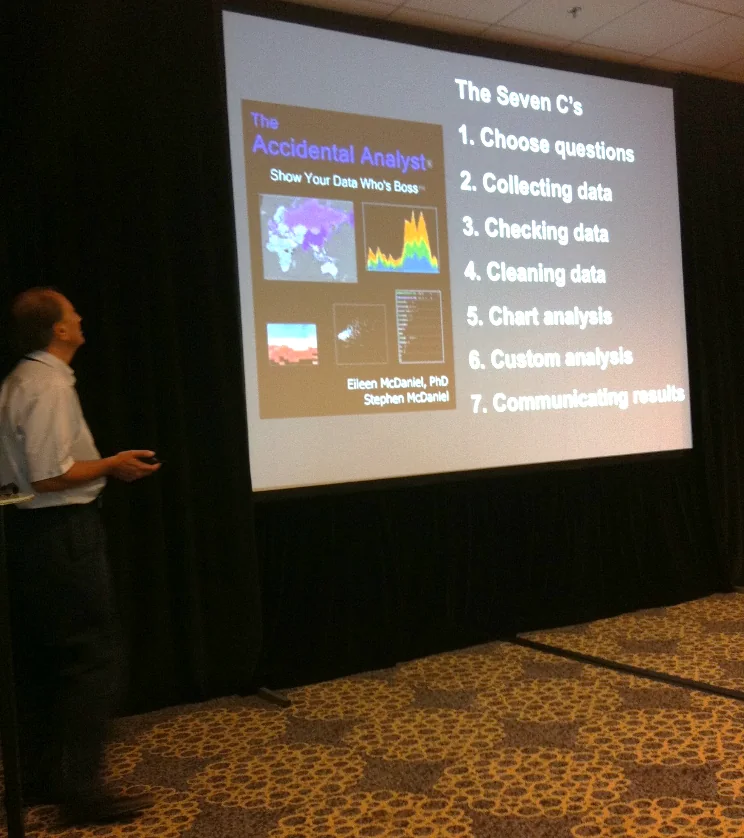
Tableau co-founder and Turing Award recipient Pat Hanrahan built part of his Tableau Conference keynote around The Accidental Analyst, and said the book changed how he thought about analytics and influenced how he taught at Stanford. The same method now guides how Stephen works with AI.
Learn more about Stephen's background →YOUR NEXT EXECUTIVE DECISION
Talk through one high-stakes analysis and whether a private team Accelerator would help.
THE ACCIDENTAL ANALYST SOCIETY
A private place for people who have taken a paid course, workshop, or training with Stephen. Bring questions, compare approaches, and keep learning together. Former students welcome.